The Phantom
Reach
Algorithmic Suppression and the Invisible Death of Independent Reach
The Day the Traffic Died
It happens without a whisper.
You sit down at your desk, log into your analytics dashboard, and find a flatline. Your organic reach didn’t just dip — it evaporated. No warning emails sitting in your inbox. No notifications of policy violations in your webmaster console. According to the dashboards, your account status is green, healthy, and compliant.
But out in the real world, you’ve become a ghost.
This isn’t a traditional deplatforming. Nobody deleted your server. Nobody locked you out of your account. The corporate gatekeepers didn’t ban you — they simply decided that you no longer exist to the public. Your domain has been quietly uncoupled from the collective consciousness of the modern web, buried beneath pages of identical, sanitized enterprise media results.
“Welcome to the age of The Phantom Reach — the silent, automated isolation of the independent voice.”
For over a decade, independent publishers, tech reviewers, and creative labels operated under a comfortable lie: if you build good infrastructure, write honest content, and optimize your platform, the audience will find you. That era is officially over.
Today’s open web has been systematically replaced by a corporate containment matrix. The modern search landscape is no longer an impartial index of human knowledge — it is a finely tuned filtering mechanism designed to protect massive media conglomerates, prioritize paid ad space, and starve independent properties of organic discoverability. When a specialized, self-hosted review site goes toe-to-toe with a multi-billion-dollar corporate network for search real estate, the algorithm doesn’t judge the quality of the signal. It judges the scale of the enterprise.
// Section 01 · Forensic Analysis
The Mechanics of The Ghosting
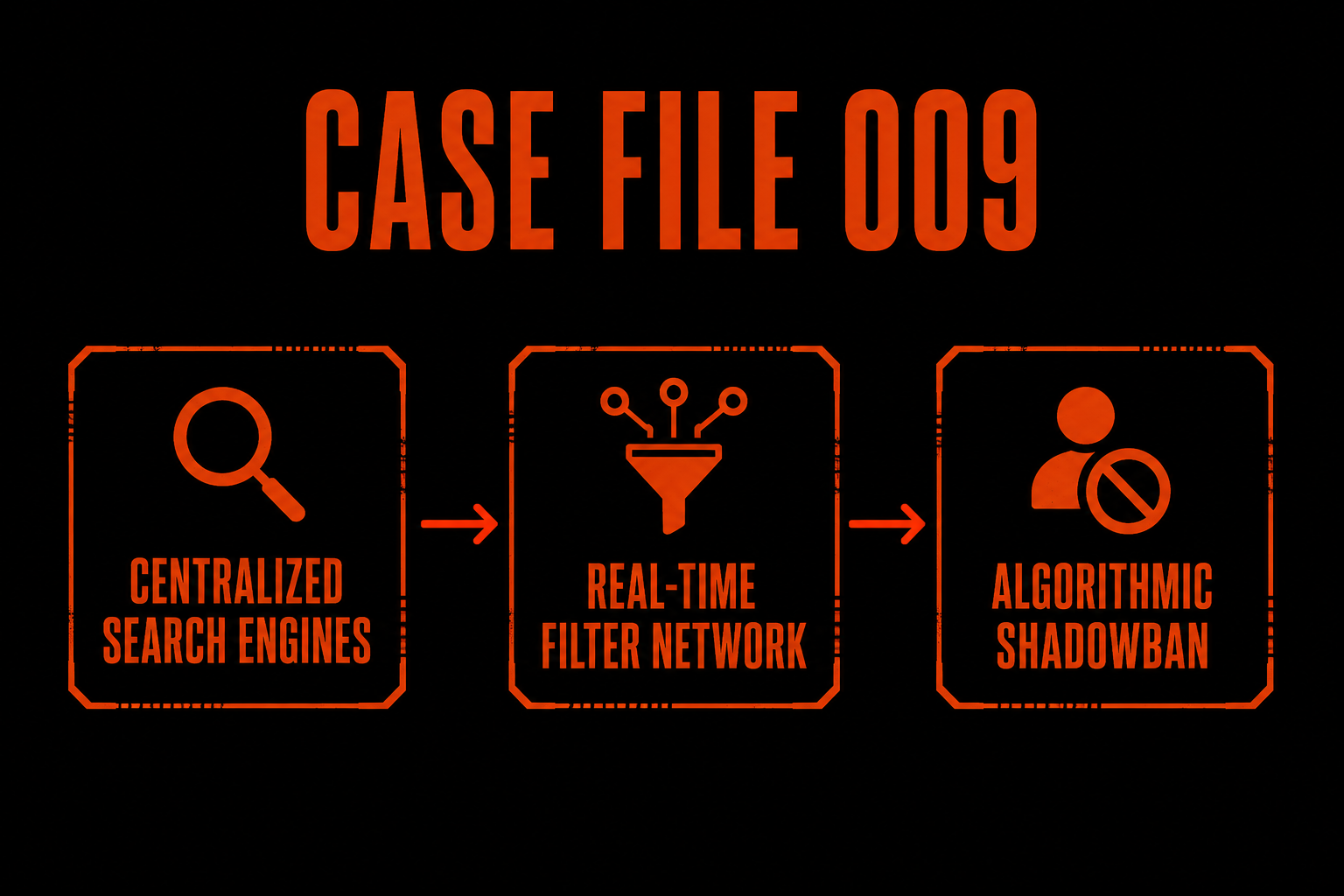
The corporate containment matrix doesn’t rely on clumsy, overt censorship. It uses a sophisticated, quiet suite of automated filters operating across three distinct layers of the web’s infrastructure.
Modern search platforms operate via massive, automated real-time filtering networks. When a domain publishes content containing specific keyword configurations or non-vetted technical analyses, automated triggers adjust the site’s visibility score instantly via internal APIs. The content remains live on your server — but its indexability status is silently modified behind the scenes.
Under the guise of protecting users from low-quality content, algorithms utilize arbitrary metrics like “authoritativeness” and “trustworthiness.” These metrics are programmatically scaled to favor established enterprise media networks with multi-million dollar backing. A deeply researched, self-hosted article is automatically down-voted by the machine simply because it lacks the corporate entity signals required to pass the algorithmic threshold.
Unlike an explicit deplatforming where an account is locked, passive containment allows you to keep publishing into a void. The machine leaves your interface fully functional so you continue feeding data into its system — while simultaneously choking your organic traffic to zero. You build. Nobody finds you. The system wins twice.
// Section 02 · Economic Warfare
The Economic Squeeze
The ultimate objective of algorithmic containment is economic subjugation. By severing the direct connection between independent properties and their communities, centralized platforms engineer an artificial visibility bottleneck.
When organic distribution is suppressed, independent operators are forced into a predatory pay-to-play paradigm. To reach the audience you spent years building, the gatekeepers demand that you rent back your visibility using their targeted ad platforms.
Concurrently, corporate affiliate networks intercept consumer search data, stripping self-hosted review spaces of direct consumer relationships and keeping creators permanently dependent on corporate infrastructure for survival. The machine only has power over the ground it owns. Stop building on rented land.
“They don’t ban you anymore. They just make sure nobody can find you.”
// Section 03 · Counter-Operations
Activating the Sovereign Stack
To survive the corporate blockade, an independent platform must transition away from centralized web reliance and activate a hardened digital footprint. The Sovereign Stack is built on three unbreakable structural layers.
Your platform must live on infrastructure you own completely. This means running a dedicated, self-hosted web node on hardened servers. If your primary corporate relationship can be dissolved by a terms-of-service update, you do not own your business — you are renting it.
Bypass the algorithmic middleman entirely by establishing unmonetized, direct distribution pipes. Cultivate decentralized RSS protocols and raw, self-hosted direct email distribution systems. When your community receives a direct data transmission from your server to their device, no search filter can intercept the signal.
Anchor your core content using localized, cryptographic signatures and alternative peer-to-peer data storage networks. By distributing indexing across independent nodes, your data becomes resilient against single-point-of-failure corporate filtering networks.
The algorithm will never love you back.
Stop designing your business around its preferences.
Harden your servers. Lock in your direct feeds.
The signal cannot be stopped when you own the sky.
Leave a Reply