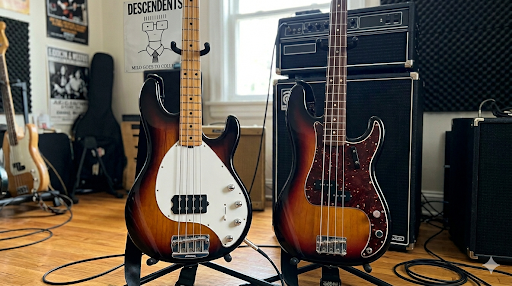
Pip: VoltEdge.blog is asking the question that has started more arguments in rehearsal rooms than tuning disputes and broken amps combined — which bass actually wins?
Mara: Justin Carl lays it all out across the low end: two legendary instruments, one philosophical wild card, and a verdict that refuses to pick a side. Let's start with the showdown itself.
The Low-End Manifesto: StingRay vs. Precision
Mara: The tension here is foundational — two basses that don't just sound different, they represent different theories of what a bass guitar is supposed to do. One commands the mix; the other holds it together.
Pip: The post frames it cleanly from the jump: "The Fender Precision Bass invented the template in 1951. The Music Man StingRay blew that template wide open in 1976."
Mara: That gap — twenty-five years of one instrument defining the rules before another arrived to break them — explains why these two still generate genuine disagreement. The StingRay brought the first active electronics ever put in a production bass: a three-band EQ, a humbucker pickup, punchy and scooped and built to cut through dense mixes. The Precision is passive, warm, and fundamental — the sound of, as the post puts it, "a million records."
Pip: The spec comparison is almost unfair to run. The StingRay lands between roughly eighteen hundred and twenty-three hundred dollars; the Precision starts around eight-fifty and climbs to eighteen hundred depending on the series. Different price ceilings, different design philosophies, both holding exceptional resale value.
Mara: Right — and the post's head-to-head breakdown makes the case that neither instrument loses. The StingRay is the gold standard for slap bass and cuts through anything; the Precision is the absolute gold standard for fingerstyle and sits perfectly in any mix. The VoltEdge take is direct: "The StingRay wins when you need to be heard. The Precision wins when you need to be felt."
Pip: Then the post does something unexpected and brings in Karl Alvarez of the Descendents as a third data point — his bass is neither of these, which is somehow the most clarifying move in the piece.
Mara: His instrument is what the post calls a "Theseus" bass — a body and neck from mismatched sources, high-output Seymour Duncan pickups chosen for aggression, and hardware with genuine personal history attached. The knobs came from a guitar smashed at a friend's final show. The post quotes Alvarez directly: "Blunt instruments for blunt people."
Pip: That line does more work than a spec sheet ever could.
Mara: It reframes the whole comparison. The StingRay and the Precision are the giants, but the Theseus proves the best bass is the one that has lived — the one with history and scars baked in. VoltEdge's AI advisor Jelena closes the verdict the same way: "Choose your weapon. Or build your own."
Pip: Low end, high stakes, and apparently a philosophy degree required.
Mara: Whether you land on active aggression, passive warmth, or something assembled from grief and second-hand parts — the argument is really about what you want an instrument to carry.
Pip: More of that from VoltEdge next time.
Leave a Reply