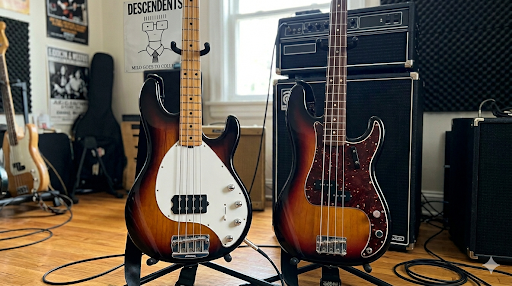
Music Man
StingRay
vs.
Fender
Precision
Two basses. Two philosophies. One defines the low-end of rock, funk, and soul. The other built the foundation that every other bass is measured against. Which one belongs in your hands? Let’s run it through the VoltEdge lens. 🦾🎸
The Contenders
When it comes to defining the sonic identity of the electric bass, two instruments stand above everything else. The Fender Precision Bass invented the template in 1951. The Music Man StingRay blew that template wide open in 1976. Both are legends. Both are still in production. Both are fought over by the best players on the planet — and they couldn’t sound more different.
- Pickups: Single humbucker (or H/HH config) — massive, aggressive output.
- Electronics: Active 2 or 3-band EQ — the first active bass ever produced.
- Sound: Punchy, scooped, snappy. Cuts through everything.
- Neck: Chunky, comfortable, wide string spacing — made for players who dig in.
- Price Range: ~$1,799–$2,299
- Pickups: Split single-coil P-bass pickup — warm, thick, unmistakable.
- Electronics: Passive — volume and tone. Nothing more, nothing less.
- Sound: Warm, fundamental, round. The sound of a million records.
- Neck: Classic C-profile, comfortable for any style from fingerstyle to pick.
- Price Range: ~$849–$1,799 (Player to American)
The “Theseus” Method
Blunt Instruments for Blunt People
To understand the soul of a bass, you have to look at players like Karl Alvarez (Descendents/ALL). His main weapon isn’t something you buy off a shelf — it’s a “Ship of Theseus” built for survival. Named after the philosophical paradox: if you replace every part of a ship, is it still the same ship?
Karl’s answer is yes — because the spirit never changes. And that spirit is built into every note he plays.
- The Build: A “fake” P-bass body bolted to a Squier Jazz neck.
- The Engine: High-output Seymour Duncan pickups — chosen for aggression, not prestige.
- The Soul: The knobs came from a guitar smashed at a friend’s final show.
It’s proof that in the hands of a master, the brand on the headstock matters less than the spirit in the wood. Karl’s Theseus bass wouldn’t win a beauty contest or a spec sheet war — but it has recorded some of the most vital punk rock ever committed to tape.
The StingRay and the Precision are the giants. But the Theseus reminds us that the best bass is the one that has lived — the one with history, scars, and soul baked into every fret.
No Compromise.
Head-to-Head Breakdown
| Category | ⚡ Music Man StingRay | 🎸 Fender Precision |
|---|---|---|
| Electronics | Active 3-band EQ — total control | Passive — simple, pure, honest |
| Pickup Type | Humbucker — thick, aggressive | Split single-coil — warm, round |
| Tone Character | Punchy, scooped, snappy | Warm, fundamental, vintage |
| Slap Bass | Born for it — the slap bass | Capable but not its strength |
| Fingerstyle | Excellent | The absolute gold standard |
| Genre Fit | Funk, slap, rock, R&B, metal | Rock, punk, jazz, country, pop |
| Recording | Cuts through dense mixes | Sits perfectly in ANY mix |
| Price Range | ~$1,799–$2,299 | ~$849–$1,799 |
| Legacy | 50 years of innovation | 75 years — invented the genre |
| Resale Value | Exceptional — holds strong | Exceptional — always in demand |
Jelena’s Verdict: No Compromise
The StingRay is a weapon. The Precision is a foundation. One was built to be heard above everything — active, aggressive, and impossible to ignore. The other was built to hold everything together — warm, passive, and utterly irreplaceable. And then there’s Karl’s Theseus bass, built from grief and friendship and second-hand parts, proving that the best instrument isn’t the most expensive one — it’s the one that carries the most life. Choose your weapon. Or build your own. 🦾🎸✨
Leave a Reply